

refusing to romanticize academia
a sensitive soul ruminates on academia's emotional toll

────────⊱◈◈◈⊰───────
The last time I wrote this newsletter it was September and I was beginning my academic career. A puny first year PhD student in the humanities. One year since then has passed and the optimism I once felt has faded.1 Maybe it has not been completely shattered, but the fallout has certainly settled into something. Deep within my heart, I feel a thick layer of sediment forming. Sticky, muddy sludge sloshing around the debris of a previous strata that once held my convictions.
Have I been crushed by the reality of pursuing the humanities in this political climate? Was it the high cost of living and my meager student stipend that did me in? The nonexistent job market? Or the realization that I’ve pledged my entire youth to yet another apathetic institution? Did a reckoning with the fact that I will never have the stability and security I desire drive a stake through my heart?
After the events of this year—packing my life and moving to a different state, the beginning of my PhD, the end of my five-year relationship, the start of a new one, and moving once more—I’ve been living adrift in a transitory mirage, juggling my emotional and intellectual sides as they’re challenged to a degree I did not know was possible. It has been a year of arduously overcoming myself. A task where again and again, academia has forced me to confront my inadequacy.
The painful act of looking yourself in the eye and telling yourself that you are not enough, to feel this truth within your very being without succumbing to self-pity, is academia’s most difficult demand—one she makes again, and again, and again. To not crumble and be fueled instead by the candor of your self-awareness takes the kind of determination and grit that I can only compare to that which I once felt as a child living through american poverty.2 As a child forced to grow up too fast and told to strive for a life bigger than her ancestors could have ever imagined when she only knew the small confines of a cold home, trudging alongside her mother’s frustrations, equally desperate to survive. Indeed, this resilience must also be the kind of power that it takes to welcome the bleakness I witnessed my mother endure as she was day to day, paycheck to paycheck, solely responsible for five children.
What is that slow deterioration that finds new ways to erode your happiness even after you thought you had none? Where does the willpower to continue spring from? From responsibilities beyond yourself? From hope? Optimism? This is the part I am still unsure about. What could possibly posses one to bear this pain for an indeterminate amount of time and no assured reward? The answer remains a mystery. I just know that it happens because since I was a child I have seen those around me and myself, like a rabid dog, refuse to cave in.3
These past few years as a university student this neuroticism, if we could call it that, has been rerouted to new channels. I’ve been constantly pushing myself to read more, demanding of myself to become a better thinker, a better writer, to be more articulate, more eloquent---there is always something to improve and that is precisely the galling pitfall. At some point this noble work of surpassing one’s base self turns into a never ending task and an unachievable standard. A twisted perseverance I am chained to. As long as I have not reached solid ground and built a home, as long as I have not found a rhythm and “healed” my wounds, as long as I have not achieved my goals, there is always more to be done.
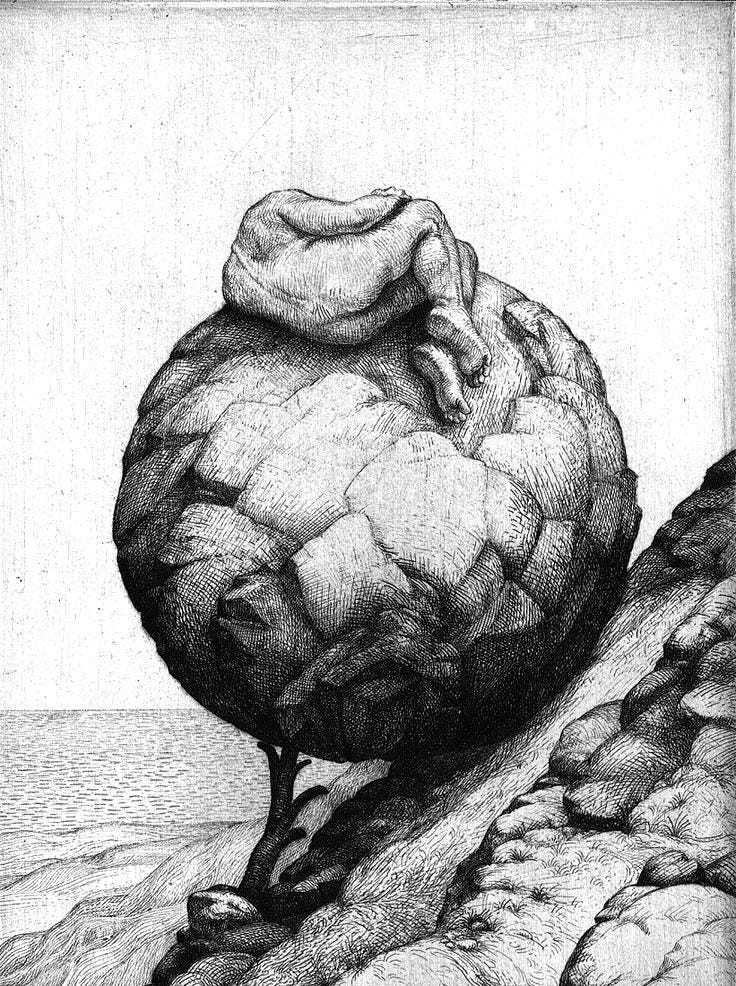
I recently read Chloe Heslip’s substack essay in which she identifies the romanticization of academia with the glamorization of overworking. Indeed, many find it virtuous and dignified to suffer in the name of a seemingly noble goal. It is, in some ways, exhilarating to be paid to lead a life of the mind. But the idea that one will live like a mad genius, driven by passion and creativity, is an ambiguously described construct. Passion doesn’t pay the bills, and creativity is often thwarted by the dullness of the inevitably mundane life we all succumb to. (I lightly touched this topic in my previous post as securing the means of your social reproduction.)
Thankfully, the glamour of academia has mostly worn out and any serious academic will tell you we are in precarious times. If they’re honest, like Karen Kelsky (@The Professor Is Out) , they might even tell you to get out while you still can. When I graduated undergrad and was still considering grad school, a professor gifted me Kelsky’s The Professor Is In, a cult classic manual for anyone braving the academic job market. My professor, who himself had found the book useful, insisted that I get a head start by knowing what awaited me and what I needed do while in grad school to maximize my chances of success. Today that might be like increasing my chances of landing a professorship from 1% to 1.1%. No wonder Kelsky’s next book is entitled The Professor Is Out—can’t wait to read that one.
Still, I am grateful for my professor’s foresight, both for informing and warning me through Kelsky’s book that I should manage my expectations by substantially sliding them towards the pessimistic side. Truly, one’s lack of information and planning can be more detrimental to a career in academia than passion can be helpful. Such is the true work of “demystifying” the academy—giving young people the information, the deadlines and documents, that they will need to plan their own paths. But this path is long, six to seven years maybe more until, if you’re extra lucky, you land a tenure track position. It can be quite disheartening.

Ultimately, this post is just another rumination amid hundreds of laments about the current state of academia. My only hope is that being this vulnerable helps “demystify the academy” a bit more. Being a PhD student is not all mental labor—reading, and researching, and overworking—but also an emotionally taxing endeavor. Because, if you are a normal human being, you are bringing all of your past baggage with you into the PhD and will probably continue to accumulate more as you go along. Admittedly, the rigor demanded by the PhD tends to consume people and balancing one’s intellectual pursuits alongside the material and emotional needs of a developing person is almost impossible.
How are you meant to balance all facets of life when the PhD dictates what you read, where and how you live, and even what you might become? What if its the opposite and you find your personal life demands all your attention, causing you to neglect your dissertation? No one has yet found an answer to this insecurity around graduate student life stability and certainty, but I have a feeling it might be related to the fact that everyone is on antidepressants and existential crises are as common as the air we breathe.
Maybe someone out there is envisioning what adding a PhD to one’s shitshow of a life is like.4 Maybe someone’s sensitive soul needs a reality check. I hope I’ve provided a hard-hitting one as life tends to be capacious and multifaceted, and if you ask me, a tediuous series of confrontations with the self that leave you exhausted and, at times, hopeless. A PhD demands this and more.

────────⊱◈◈◈⊰───────
If you made it this far, thank you for reading The Scholar, an occasional publication where I try to rediscover my academic curiosity. I write about literature, my PhD life, and other cryptic topics—consider subscribing to follow along on my journey and maybe start yours too. Don’t let this post discourage you. And if it does, you can always come back another time just like I did with this substack, resurfacing after a surprise year-long hiatus.
To be fair, the optimism I felt before starting grad school was already close to zero.
I say american because it is a very particular brand of poverty. If you know, you know.
Doing some autoethnographic research right here.
I KNOW some of y’all are thinking of doing a PhD to escape the responsibilities of adulting / the bleakness of life. You’re fooling yourself because the PhD is just a massive addition to the adult responsibilities.
I think what many of us love about academia is the idea of freedom behind it.
We romanticize the endless possibilities of deepening our knowledge — something many of us would do for free anyway.
The problem is that institutions know this.
And over time, that love can become a lever: constant pressure, constant comparison, and the feeling of never being quite “up to standard”.
Sometimes I wonder who built this machine of standards in the first place.
It would be nice if we could rewrite academia around more humane standards — ones that enrich people rather than drain them to the bone.
In the meantime, I really wish you the best with your career and life.
Absolutely relatable. I finished ( engineering PhD), at great cost to self. No longer at ease or the same.